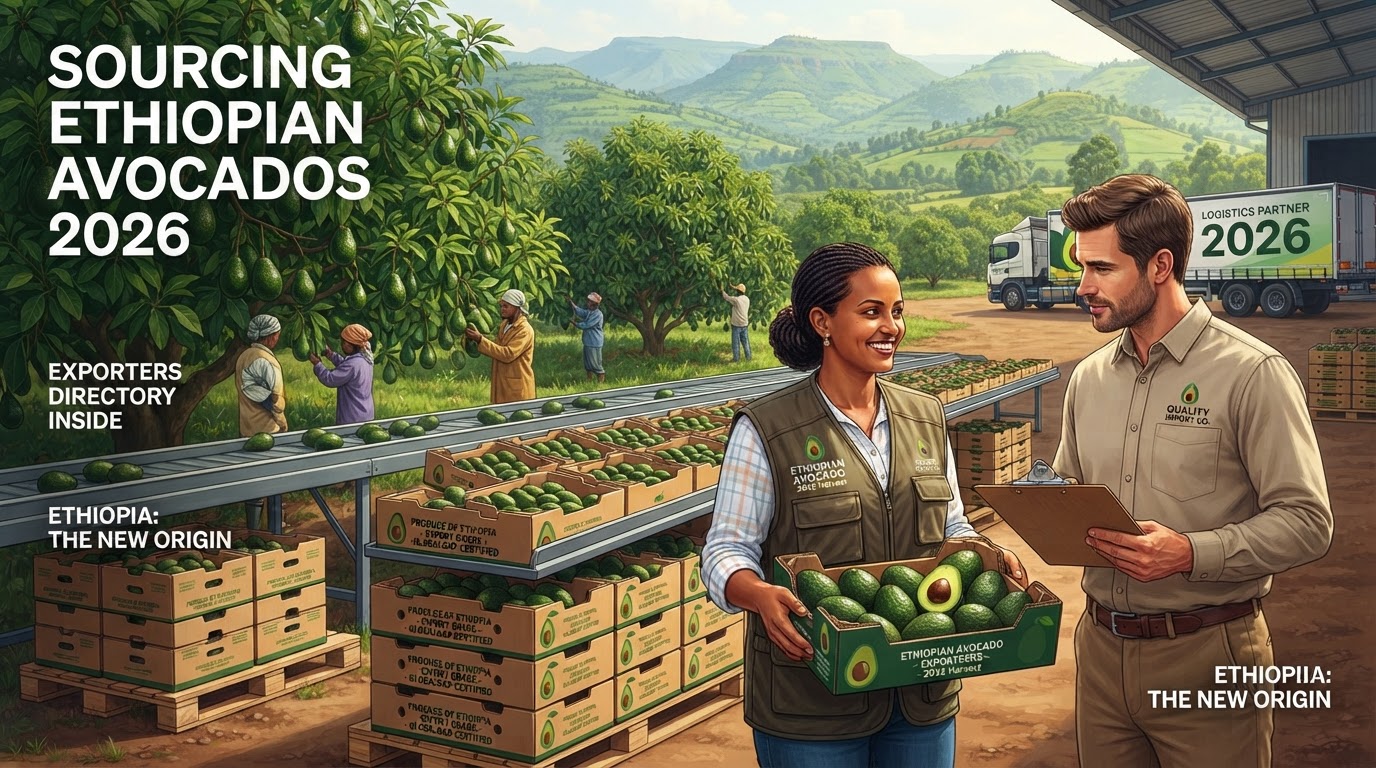
Ethiopia Is Emerging as an Avocado Sourcing Origin
International avocado sourcing is normally associated with established origins such as Mexico, Peru, Chile, Colombia, Kenya, South Africa and Morocco.
Ethiopia is a smaller player, but its avocado value chain is developing quickly.
The country has favorable growing areas, a large smallholder agricultural base and expanding investment in horticulture, processing and export-oriented supply chains.
In March 2026, the United Nations reported that avocado has become a priority commodity within Ethiopia's Integrated Agro-Industrial Park development, with more than 65,000 smallholder farmers connected to structured avocado supply systems. Sidama and Oromia were highlighted as important emerging production hubs. See the United Nations Ethiopia avocado value-chain report.
That does not mean every Ethiopian avocado producer is immediately ready to serve an international supermarket or importer. It means buyers now have another origin worth evaluating.
Quick Answer: How Do You Source Ethiopian Avocados?
A professional sourcing process should move through:
product specification → suitable exporter → farm/supply base → certification → quality assessment → residue requirements → packhouse → packaging → cold chain → phytosanitary documentation → quotation → shipment
The product itself must come first.
An importer asking only “Please send your avocado price.” has not given an exporter enough information to prepare a meaningful commercial quotation.
A better buyer tells the exporter the variety, count/size, required volume, destination, packaging, certification requirements, Incoterm and delivery window.
Start With Ethiopian Exporters That Actually Handle Avocados
The fastest way to waste time in international sourcing is to contact businesses that are only loosely connected to the product you want.
General internet searches can mix avocado farmers, domestic wholesalers, fruit retailers, brokers, exporters, processors, produce companies and businesses whose listings may no longer reflect their active operations.
Gizye approaches that problem from the business side.
International buyers can start with the Ethiopian avocado exporter search on Gizye and evaluate businesses associated with relevant Ethiopian trade activities before opening a sourcing conversation.
Browse Ethiopian avocado exporters on Gizye.
Hass Is Particularly Important for Export Buyers
Ethiopia grows different avocado types, but Hass is particularly important for the fresh export market.
A recent assessment of Ethiopia's avocado value chain reported that Hass dominates current avocado exports and described exporters sourcing fruit through cooperatives, grower clusters and individual producers rather than relying exclusively on exporter-owned farms.
The same assessment highlighted issues such as GLOBALG.A.P. certification, maximum-residue-level testing, packhouse arrangements and cold logistics as important parts of export preparation. See the Ethiopia avocado value-chain assessment.
That sourcing structure matters to international buyers.
- Where is the fruit grown?
- How many farms supply the program?
- Is the production base certified?
- How is fruit collected?
- Where is it packed?
- How quickly does it enter the cold chain?
- Can the exporter maintain consistent specification across the shipment?
Those answers are more valuable than the variety name alone.
Hass vs Other Avocado Varieties
Hass dominates many premium international avocado markets because of its relatively durable skin, established ripening characteristics and strong buyer familiarity.
However, the correct variety depends on the buyer's market.
A wholesale buyer supplying a regional market may accept different varieties than a European retailer running a tightly standardized Hass program.
For this reason, an RFQ should state explicitly Variety: Hass rather than simply Product: Avocado if Hass is mandatory.
If other varieties are acceptable, tell exporters that as well. It can expand your sourcing options.
Fruit Size Matters
Avocados are frequently traded according to size or count specifications.
The buyer therefore needs to establish the required commercial size profile rather than buying only by total weight.
Different customers may prefer different size ranges depending on retail pack format, consumer preference, food-service use and destination-market convention.
An exporter should be able to explain how fruit is graded and packed.
If you require particular counts per carton, write them directly into the RFQ.
For example, Required sizes: 14 / 16 / 18 / 20 / 22 is considerably more useful than Medium and large avocado wanted.
The buyer and exporter should agree the actual applicable grading convention before contracting.
Maturity Is Just as Important as Appearance
An avocado can look excellent at origin and still perform badly after transport.
Export buyers therefore need to think about physiological maturity, not merely external appearance.
Fruit harvested too early may ripen poorly. Fruit harvested too mature may soften before reaching the destination.
Professional avocado programs can therefore use maturity indicators and quality checks appropriate to the buyer's specification.
Depending on the program, these may include parameters such as dry matter, firmness, fruit condition, defects and ripening behavior.
The exact acceptance specification should be agreed between buyer and exporter.
For a long-distance refrigerated shipment, maturity management becomes especially important because the fruit must survive harvesting, packing, inland transport, international freight, destination handling and potentially additional ripening before reaching the final customer.
Buyers Should Define the Quality Specification Before Asking for Price
Imagine two Ethiopian exporters offer Hass avocado. Exporter A quotes a lower price. Exporter B is more expensive.
Without specifications, that tells you almost nothing.
Exporter B might be offering certified production, tighter size grading, stronger packhouse controls, residue testing, better packaging, pre-cooling and a more mature cold-chain program.
That is the same principle serious buyers apply across fresh produce sourcing globally.
GLOBALG.A.P. Can Be Very Important to International Avocado Buyers
GLOBALG.A.P. is not a universal government requirement for every avocado entering every country. But commercially, it can be extremely important.
Many international retailers, produce importers and organized supply chains use GLOBALG.A.P. certification as part of supplier qualification.
GLOBALG.A.P. says its certification is used across more than 130 countries and involves independent third-party audits covering areas including food safety, environmental practices, worker health and welfare, traceability and farm-management processes. Certification status can be checked using the producer's GLOBALG.A.P. identification number. See GLOBALG.A.P. information for buyers.
- Are the farms supplying this lot GLOBALG.A.P. certified?
- What is the GGN?
- Does the certification cover avocado?
- Which production sites are included?
- Is the certificate currently valid?
That is much stronger than simply accepting a PDF carrying a GLOBALG.A.P. logo.
GLOBALG.A.P. Certification Belongs to the Production Scope
There is an important distinction.
If an exporter works with 500 farmers and only 100 are included in a certified production group, the exporter should not imply that every avocado it handles is GLOBALG.A.P. certified.
Buyers should establish whether the specific fruit being purchased comes from the certified production scope.
This is why certification needs to connect eventually to exporter → producer/farm → lot → shipment rather than existing as a generic company badge.
Pesticide Residues Are a Serious Buyer Specification
For fresh produce entering markets such as the European Union, pesticide residue requirements deserve attention very early in the sourcing process.
The EU establishes Maximum Residue Levels (MRLs) for pesticides in food. Imported food is subject to the same applicable MRL framework as food produced within the EU, and the European Commission maintains a searchable pesticide database for current values. See the EU Pesticides Database.
So an EU avocado buyer may reasonably ask an Ethiopian exporter for recent residue-test results, pesticide-use records, farm-control procedures and information about the laboratory used for testing.
Retailers can also impose requirements stricter than the general statutory limit.
Testing after the container is already ready to leave is very late in the process.
Phytosanitary Documentation Is Important for EU Avocado Imports
Fresh-produce buyers should also establish the applicable plant-health requirements before shipment.
Under current EU plant-health rules, plants and many plant products entering from non-EU countries require phytosanitary certification unless specifically exempted.
The European Commission notes that only a small group of fruits — pineapple, coconut, durian, banana and dates — fall under the general fruit exemption. See the EU plant-health rules.
Fresh avocados are specifically identified under customs code 0804 40 00 among products requiring phytosanitary certification under relevant EU import-control rules. See the applicable EUR-Lex regulation.
The phytosanitary certificate is issued by the exporting country's competent plant-protection authority and supports confirmation that the consignment has been inspected and meets applicable plant-health requirements.
What Is the HS Code for Fresh Avocados?
At the international six-digit HS level, avocados are generally classified under HS 080440 — Avocados, fresh or dried.
The more detailed tariff code used at destination can extend beyond six digits.
Buyers should verify the exact national tariff classification with their customs authority or broker before importing.
Correct classification affects customs declarations, tariffs, statistics, import controls and potentially documentation requirements.
The Packhouse Can Determine Whether Good Fruit Arrives as Good Fruit
The farm produces the avocado. The packhouse prepares it for the international supply chain.
For serious fresh-produce buyers, understanding the exporter's packhouse arrangement is therefore essential.
- Where is fruit received?
- How is it inspected?
- How is it sorted and graded?
- How is it packed?
- How is it pre-cooled?
- How is it loaded for export?
Also ask whether the exporter owns the facility or uses a third-party packhouse.
Neither arrangement is automatically superior. What matters is whether the process can consistently achieve the agreed specification.
Pre-Cooling and Cold Chain Matter Enormously
Fresh avocado is a living, perishable product. Temperature management therefore becomes part of the product itself.
- How quickly is fruit cooled after harvesting?
- Where is it pre-cooled?
- At what temperature is it held?
- How is temperature maintained during inland transport?
- Is temperature monitoring available?
- What happens during transfer between packhouse, inland logistics and international transport?
A beautiful avocado that spends too long outside an appropriate cold chain can become a poor commercial shipment.
Ethiopia's Logistics Are Improving, but Buyers Should Evaluate the Actual Route
Ethiopia is landlocked. That gives fresh-produce logistics an additional level of complexity.
Fresh produce may move by air, while sea-freight development increasingly focuses on refrigerated supply chains connecting Ethiopian production and packing areas through inland logistics to Djibouti.
Ethiopia has previously demonstrated refrigerated avocado movement through the Modjo–Djibouti corridor, and current initiatives continue to focus on strengthening cold-chain infrastructure and export logistics.
Recent reporting indicates controlled fresh-produce sea-freight trials and infrastructure development remain active areas of work. See the AJOT overview of East African fresh-produce sea freight.
The exporter should be able to identify the packhouse, inland transport method, consolidation location, port or airport, temperature-control arrangement, freight provider and expected transit plan.
Air Freight vs Sea Freight
Air Freight
Air freight offers speed. It may make sense for smaller quantities, high-value programs, urgent deliveries or supply chains where sea transit is not commercially viable. The disadvantage is cost.
Refrigerated Sea Freight
Sea freight can potentially make larger commercial volumes more competitive.
But it demands much stronger control over maturity, packing, pre-cooling, reefer settings, inland transit, port handling and overall journey time.
This means a buyer should not assume that because an exporter can successfully airfreight avocado, the same exporter is automatically ready for a long refrigerated sea journey. Ask specifically about experience with your intended transport mode.
Packaging Should Be Part of the RFQ
Do not wait until the sales contract to ask how the fruit will be packed.
For fresh avocados, packaging affects fruit protection, ventilation, pallet efficiency, cooling, labeling and destination handling.
- Carton net weight
- Count/size configuration
- Carton construction
- Ventilation
- Labeling
- Pallet configuration
- Retailer-specific requirements
For example, 4 kg export cartons may be acceptable for one buyer while another has a different standard.
Do not copy a generic specification from the internet and assume it applies to every customer.
The correct packaging is the packaging agreed between the exporter, importer and intended market.
Traceability Is Becoming More Valuable
Fresh-produce buyers increasingly expect exporters to identify where their products came from.
A strong Ethiopian avocado exporter may be able to connect export lot → packhouse → grower group/cooperative → farm rather than merely saying Origin: Ethiopia.
That matters for food-safety investigation, certification scope, residue controls, quality management and buyer transparency.
As Gizye's future compliance architecture develops, this can eventually become structured digital information rather than a collection of disconnected spreadsheets and certificates.
- Farm traceability available
- GLOBALG.A.P. scope verified
- Lot source records available
- Residue evidence available
Sensitive grower information should remain private while buyers receive the evidence they need for procurement decisions.
Ethiopian Avocado Exporters Often Depend on Farmer Networks
International buyers should understand that an exporter does not necessarily own the orchards producing its fruit.
Ethiopia's current avocado export system can involve cooperatives, organized farmer groups and individual growers supplying exporters and packhouses.
That is perfectly normal if the supply chain is properly managed.
- Can the exporter control the production specification?
- Can it identify the farms supplying the lot?
- Can it enforce pesticide and harvest requirements?
- Can it segregate certified and non-certified fruit where necessary?
- Can it maintain traceability from farm to shipment?
That is what converts an agricultural supply network into an export program.
Quality Problems Often Start Before the Packhouse
Fresh-produce quality cannot be created entirely after harvesting.
Exporters need production networks capable of controlling crop protection, harvest timing, fruit handling and farm-level quality.
A packhouse can sort poor fruit out. It cannot turn immature, damaged or badly handled fruit into premium export avocado.
This is another reason buyers should evaluate the exporter's supply base rather than only its office and sales presentation.
Ask About Rejection and Sorting Standards
A serious exporter should have criteria for fruit that does not enter the export pack.
- Mechanical damage
- Pest damage
- Disease
- Excessive surface defects
- Poor shape
- Inappropriate maturity
- Other buyer-defined defects
The exact tolerance depends on grade and market.
If the supplier cannot explain how fruit moves from bulk collection into the final export grade, that deserves additional investigation.
Residue Testing Should Match the Lot and Market
Seeing one laboratory report does not automatically prove every future shipment meets your requirements.
- What farms or lot does this test cover?
- When was the sample taken?
- Which pesticides were tested?
- Which laboratory performed the analysis?
- Was the test designed against my destination's requirements?
For repeat procurement, buyers may establish an agreed sampling and testing program rather than treating testing as a one-time onboarding exercise.
Certifications Should Be Verified, Not Merely Displayed
When an exporter claims a certification, buyers should verify the certificate holder, certificate number, certification scope, covered farms or sites, products, expiry and status.
GLOBALG.A.P., for example, supports verification of certification status using applicable producer identifiers. See GLOBALG.A.P. information for buyers.
This is exactly why Gizye's longer-term compliance approach should go beyond exporter uploads PDF → badge appears.
How to Compare Ethiopian Avocado Exporters
Do not rank suppliers only by price.
- Business legitimacy — Is this an established Ethiopian business with the relevant trade activity?
- Supply — Can the exporter provide the volume and variety required?
- Production base — Which farms or cooperatives supply the fruit?
- Certification — Does the required certification cover the relevant production?
- Residue control — Can the exporter support the buyer's pesticide/MRL requirements?
- Packhouse — How is fruit graded, packed and pre-cooled?
- Cold chain — Can appropriate temperature conditions be maintained?
- Traceability — Can the lot be linked back through the supply chain?
- Shipping — Does the exporter understand the intended logistics route?
- Communication — Are technical and commercial questions answered clearly?
- Documentation — Can the exporter arrange the documents required for the destination?
- Performance — Can it deliver the agreed specification consistently rather than only producing one good sample?
What Should an Ethiopian Avocado RFQ Include?
A buyer inquiry could look something like this:
- Product: Fresh Hass avocado
- Origin: Ethiopia
- Required volume: 20 MT per shipment
- Sizes: 14 / 16 / 18 / 20 / 22
- Quality: Export Grade / buyer specification attached
- Certification: GLOBALG.A.P. required
- Residue requirement: EU MRL compliant; recent residue analysis requested
- Packaging: 4 kg ventilated export cartons
- Destination: Rotterdam, Netherlands
- Shipment: Refrigerated sea freight preferred
- Incoterm: FOB and CFR quotations requested
- Shipment window: Please advise availability
- Documentation: Commercial invoice, packing list, certificate of origin where applicable, phytosanitary certificate and requested quality documentation
- Please provide: Farm/producer structure, packhouse information, certification reference, available volume, maturity specification, cold-chain arrangement and quotation validity
Compare that with “Hello, avocado price?”
The first inquiry gives a professional exporter enough information to determine whether the opportunity fits its program.
Samples for Fresh Produce Are Different From Coffee Samples
A coffee exporter can send a small representative green-coffee sample by courier.
Fresh avocado is more difficult because maturity, season, transport time and ripening influence the evaluation.
Depending on the commercial opportunity, buyers may rely on fruit samples, inspection photos, video inspection, quality reports, third-party inspection, trial consignments or visits to the packhouse or farm.
For a new large-volume relationship, a controlled trial shipment can sometimes provide more useful commercial evidence than photographs alone.
Agree Inspection Rules Before the Shipment Moves
The buyer and exporter should establish where quality will be assessed and what constitutes acceptance.
- Packhouse inspection
- Pre-shipment inspection
- Loading inspection
- Destination inspection
The agreement should also address how defects, count differences or quality disputes are measured.
That becomes especially important in future Gizye transactional workflows because escrow or release conditions should depend on explicit contractual milestones, not vague expectations.
Don't Ignore the Importer's Responsibilities
The Ethiopian exporter handles the origin side of the transaction. The buyer still needs to understand destination requirements.
An EU importer, for example, must consider applicable plant-health controls, pesticide MRL requirements, customs obligations and any private buyer or retailer standards.
Current EU rules require relevant plant products entering from third countries to undergo documentary and plant-health controls. See the European Commission import inspection guidance.
The two sides need to meet in the middle.
What Documents May Accompany an Avocado Shipment?
Depending on destination and transaction, the buyer may encounter:
- Commercial invoice
- Packing list
- Export/customs declaration
- Certificate of origin where applicable
- Phytosanitary certificate
- Bill of lading or air waybill
- Inspection documentation
- Residue-test reports
- Certification evidence
- Other destination-specific documents
The exact set should be determined for the specific shipment.
Never assume a document used for one country's avocado import is automatically required by every other country.
Payment Should Follow the Agreed Commercial Relationship
Gizye currently focuses on exporter discovery, verification and buyer-seller connection rather than processing the underlying commercial transaction.
The buyer and exporter therefore agree their payment arrangement directly.
Buyers should confirm that invoice and payment information corresponds with the business they are dealing with and confirm payment instructions directly with the exporter before sending funds.
As Gizye evolves toward V2, protected transaction structures such as regulated escrow could eventually provide another layer between verified supplier discovery and shipment execution.
For the current marketplace, however, supplier discovery and verification remain the starting point.
How Gizye Helps Avocado Buyers
The first sourcing problem is finding the right business.
Gizye helps buyers search Ethiopian exporters using business and trade information rather than relying only on advertisements or unstructured internet listings.
For avocado sourcing, the buyer can begin at Browse Ethiopian avocado exporters.
Then move through exporter discovery → business review → supplier shortlist → inquiry → technical discussion → commercial evaluation.
As Gizye's compliance capabilities develop further, the same exporter profile can eventually combine active licence information with GLOBALG.A.P. verification, plant-health readiness, residue evidence, farm or lot traceability and market-access information.
Ethiopia's Avocado Opportunity Is Broader Than Fresh Fruit
Fresh export is only one side of the avocado economy.
Ethiopia's avocado processing industry is also growing.
The United Nations reported in 2026 that processors around the Yirgalem Integrated Agro-Industrial Park are producing avocado oil, including organic avocado oil for European export markets, while linking tens of thousands of farmers into more structured supply networks.
That creates another potential Gizye sourcing cluster later: Ethiopian avocado oil manufacturers, organic avocado oil exporters and bulk avocado oil suppliers.
Fresh avocado and avocado oil serve very different buyers, however, so they should not be combined into one generic supplier query.
This article focuses specifically on fresh avocado sourcing.
Is Ethiopia Ready to Compete With Major Avocado Origins?
Ethiopia does not need to replace Peru, Mexico or Kenya to become commercially interesting.
A buyer may source from Ethiopia because of seasonal diversification, supplier diversification, emerging production programs, geographic positioning or commercial opportunity.
But emerging origins have to prove consistency.
That means the strongest Ethiopian exporters will need to demonstrate reliable supply, standardized export quality, certification where buyers require it, residue control, packhouse capability, traceability, cold-chain management and reliable logistics.
That is where an emerging origin turns into a repeat sourcing origin.
Frequently Asked Questions
Does Ethiopia export avocados?
Yes. Ethiopia has an active and developing avocado export value chain, with Hass particularly relevant to fresh exports. The sector also includes a growing avocado-processing and avocado-oil industry.
Where can I find Ethiopian avocado exporters?
International buyers can search relevant Ethiopian businesses through Gizye: Find Ethiopian avocado exporters.
Which Ethiopian avocado variety is best for export?
Hass is particularly important in international fresh-avocado trade and currently dominates Ethiopia's export-oriented avocado supply according to recent value-chain research. The right variety still depends on the buyer's market and specification.
Do Ethiopian avocado exporters need GLOBALG.A.P.?
GLOBALG.A.P. is not universally required by law for every avocado transaction, but many international retailers and produce buyers require or strongly prefer certified production. Buyers should state certification requirements in their RFQ.
Does avocado exported from Ethiopia to the EU need a phytosanitary certificate?
Under current EU plant-health rules, fresh avocados imported from third countries fall within products requiring phytosanitary certification. Buyers should still confirm the exact current requirements for their transaction and entry point.
What is the HS code for avocado?
At the international six-digit level, avocados are generally classified under HS 080440 — Avocados, fresh or dried.
Are pesticide residues important for EU avocado imports?
Yes. EU pesticide MRL requirements apply to imported food as well as EU-produced food. Buyers should establish applicable residue requirements and testing expectations with the exporter before shipment.
Can Ethiopian avocados be shipped by sea?
Refrigerated sea-freight corridors have been demonstrated and continue to receive development attention, particularly through the Ethiopia–Djibouti logistics corridor. Actual commercial feasibility depends on exporter capability, route, fruit condition, reefer management and buyer requirements.
Can Gizye guarantee avocado quality?
No marketplace profile replaces product inspection. Gizye helps buyers identify and evaluate relevant Ethiopian businesses; avocado quality, specification and shipment acceptance should be agreed and verified for the actual transaction.
Does Gizye handle the payment?
Not currently. Gizye focuses on exporter discovery, verification and buyer-seller connection. Payment arrangements are agreed directly between buyer and exporter.
Buyer Checklist Before Ordering Ethiopian Avocados
Before committing to a commercial shipment, confirm:
- Exporter identity and relevant Ethiopian trade activity
- Avocado variety
- Farm/producer sourcing structure
- Available commercial volume
- Harvest/shipment window
- Required fruit sizes/counts
- Maturity specification
- Quality and defect tolerance
- GLOBALG.A.P. or other certification requirements
- Certificate scope and validity
- Pesticide-residue requirements and testing
- Packhouse arrangement
- Pre-cooling procedure
- Packaging specification
- Cold-chain capability
- Traceability
- Phytosanitary requirements
- Destination-country import requirements
- Freight mode and route
- Incoterm
- Commercial documents
- Payment terms
- Agreed inspection and acceptance procedure
That checklist does more to protect the commercial outcome than simply finding the lowest quoted carton price.
From Supplier Search to a Repeat Avocado Program
The most valuable international sourcing relationships are rarely built from one email.
They develop through a sequence: define the avocado specification → find relevant Ethiopian exporters → verify supplier capability → review certification and supply base → confirm residue requirements → evaluate fruit/quality → agree packaging → confirm cold-chain and logistics → agree documents and commercial terms → run the shipment → evaluate arrival quality → improve the next shipment.
That is how an importer moves from testing a new origin to building a dependable sourcing program.
Find Ethiopian Avocado Exporters on Gizye
Ethiopia's avocado export opportunity is developing, but buyers still need a practical way to identify the businesses capable of turning agricultural production into an international shipment.
Gizye gives buyers a more structured place to begin.
Browse Ethiopian avocado exporters on Gizye.
For international buyers exploring Ethiopia as a fresh-produce origin, that is a much stronger starting point than searching through disconnected company names and hoping each one is actually relevant.
Authoritative Resources
For additional independent reference, buyers can review the United Nations Ethiopia avocado value-chain report, the Ethiopia avocado value-chain assessment, GLOBALG.A.P. information for buyers, the EU Pesticides Database, and the European Commission plant-health guidance.